Using agentic AI to curate tasks for users
We recently wrote about how AI agents might create space for planning and make their work visible. This involves defining:
- the basic units of work we offer to our users
- packaging up lists of tasks
- being clear about statuses and next steps
To enable this, we’ve been working on the data that allows tasks to be organised in coherent ways for our users.
In a test environment, we’ve given our AI-enabled Chat agent access to a ‘knowledge graph’ of GOV.UK services. This knowledge graph is essentially a big map of all the government services available to it, showing how the different services are related to each other and when each should be used. We’ve also given our agent instructions to choose services based on what it thinks the user’s current goals are.
What becomes obvious quite quickly with this environment is that our agent can flexibly curate bundles of services in different ways to match people’s current needs. And for system design, this presents interesting opportunities. For example, it might remove the need to design around singular, fixed mental models — which are sometimes problematic because people do not all think in the same way, and real use is often more varied than design can predict.
Designing for fluid mental models
When we allow our agent to work flexibly, it can curate experiences based on each user’s own unique ways of framing things. Some of the services we’re exploring are not yet in place across government, but we’re interested in seeing how agents can work with multiple services.
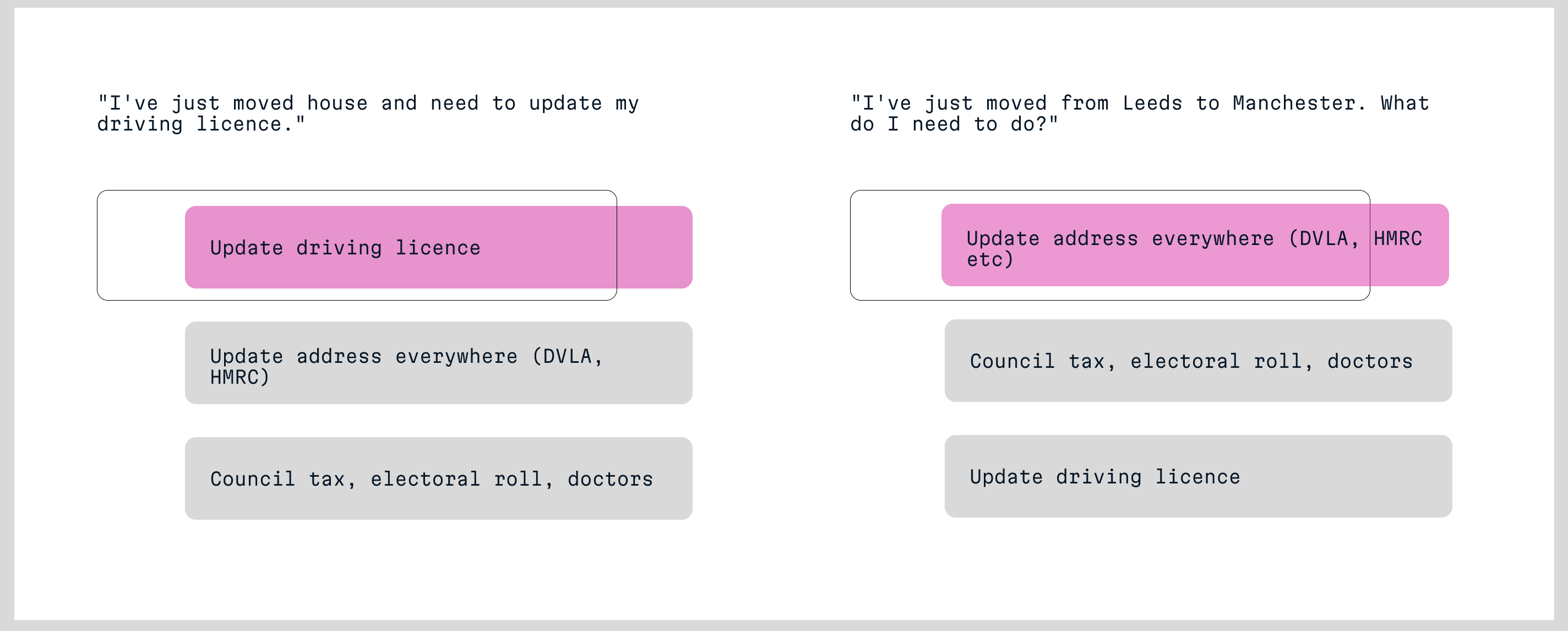
For example, if someone tells us they’ve moved house and want to update their driving licence — we can get that driving licence updated first then offer other tasks related to moving house.
If someone tells us they’ve recently moved and are not sure what to do — we could, for example, get their address updated across government, then show them a list of other things they might still need to do, like registering for council tax or the electoral register.
We’ve been giving lots of example scenarios to this system, and observing what bundles of tasks the agent compiles. We’re looking for combinations of tasks that would make sense for different use cases – seeing where it performs well, and where it makes mistakes – in order to refine what kinds of instructions we need to give our agent.
We’ve found that there could be some broad patterns for combining tasks. Not strict rules, but more abstract patterns that might be useful for our agent to know about.
Flexible task patterns
There are at least 3 types of task patterns emerging from our work so far.
Task bundles
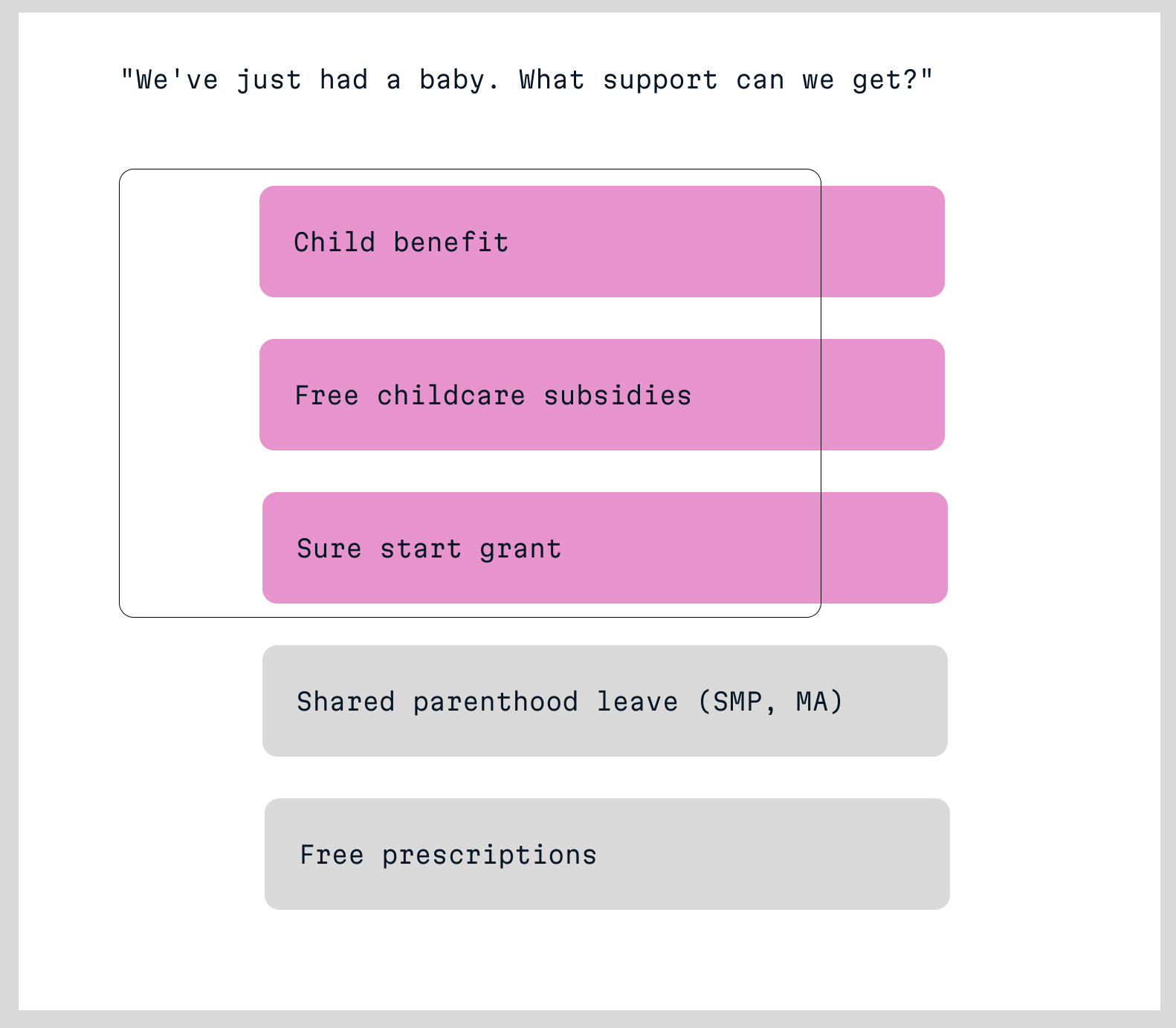
It’s often the case that a user’s situation requires them to do more than one thing. We can bundle these tasks together and prioritise them depending on the immediate need of the specific user.
In this case, we might want to bundle together similar things, like updating the address records across different departments. Or we might want to bundle together all the tasks related to financial support.
Complex plans
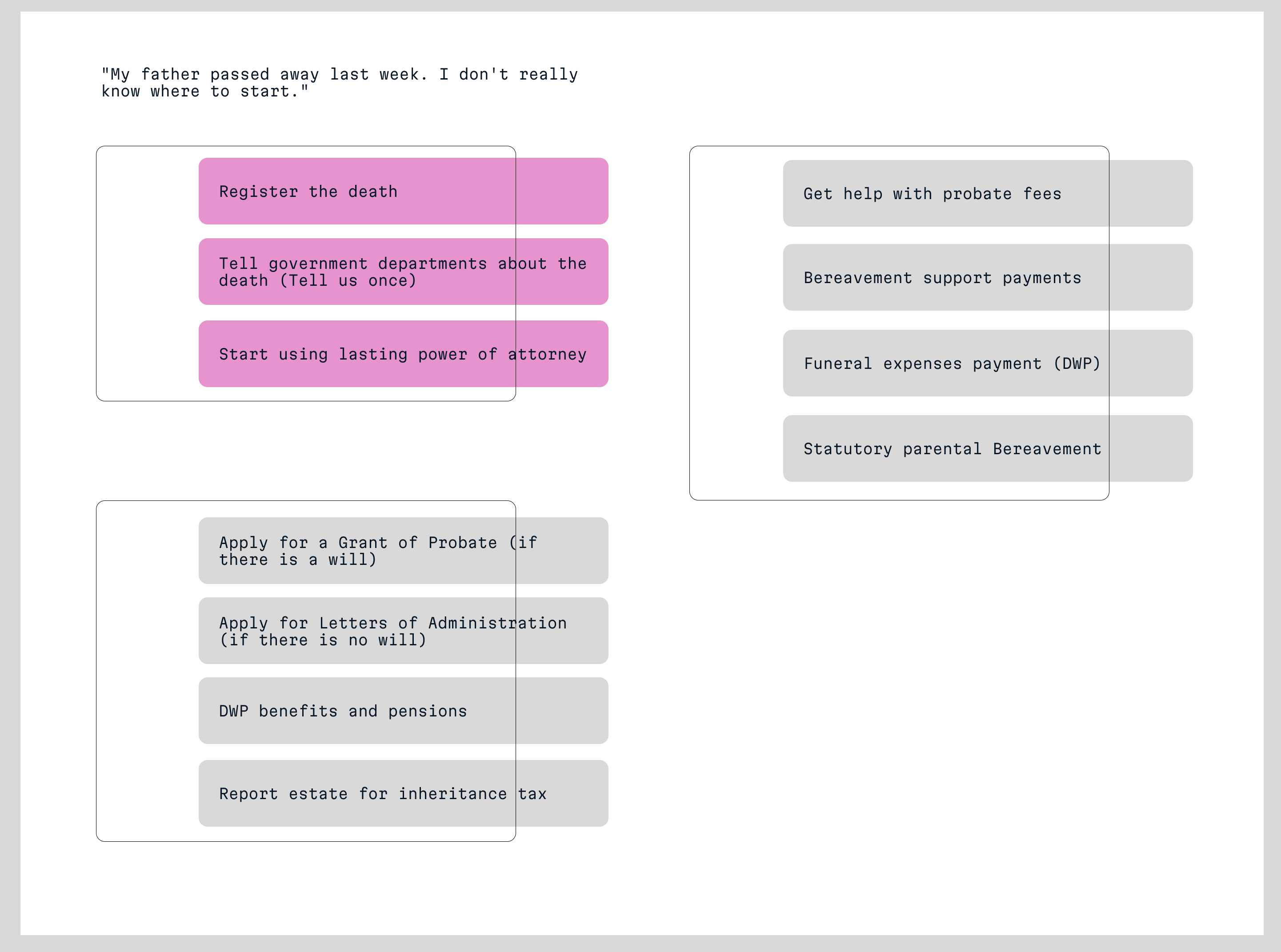
Some situations are complex and involve many associated tasks. In these cases, we need to design against overwhelm and cognitive load.
We want to find ways to chunk up these complex scenarios into manageable bundles of tasks.
We can instruct our agent to bundle up tasks based on things that need to be done ‘now’ and ‘later’. The agent could also prioritise types of tasks. For example, it could offer to assist a user in applying for financial support early on in a process, especially if it’s likely to take time to receive it.
For these kinds of scenarios, there’s a tension between helping people plan ahead and showing information that isn’t yet relevant. We want to experiment with different ways of offering these complex plans.
Discrete tasks
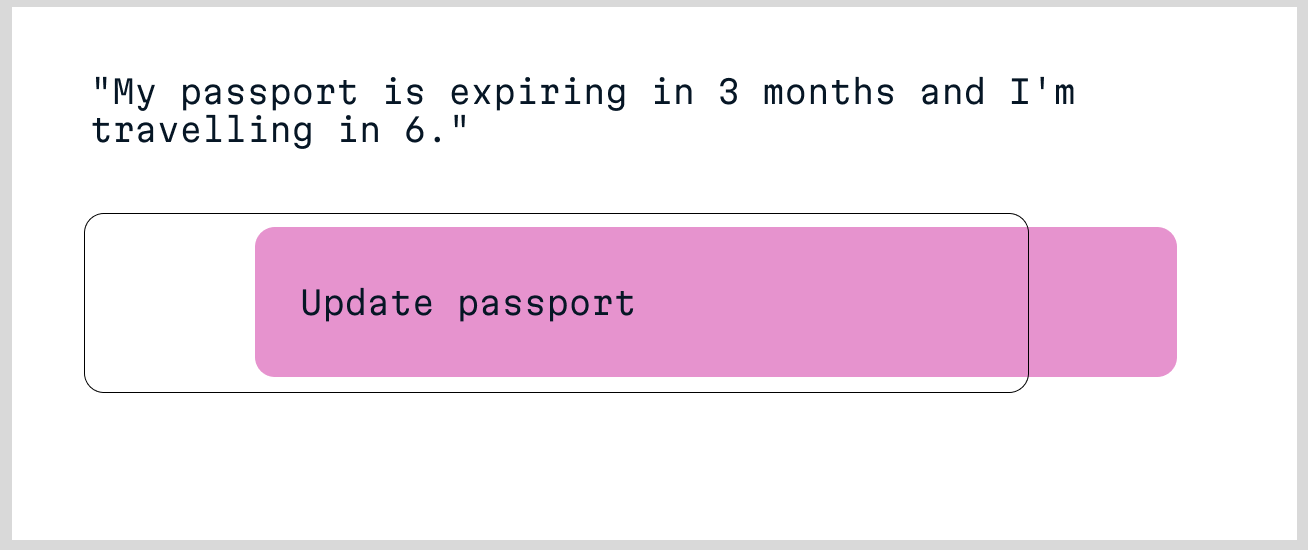
Of course, there are discrete tasks, too – like when someone simply wants to update their passport.
Other micro patterns
There are also some common micro patterns emerging, for example:
— there is often a prerequisite question the agent needs to ask before it can confidently offer actionable tasks, for example, with child support it first needs to know if the birth has been registered
— there are times when offering alternatives is important, such as when someone asks about council housing but they could be better off applying for housing benefit
— if we are offering users lots of related tasks and next steps, they don’t want this to continue endlessly. Once a user’s initial goals are met, we think the agent should summarise the progress made so far, and offer a moment of reflection and closure
Agents doing the hard work to make it simple
The main benefit of this approach to curating tasks is it can protect users from the complexity of cross-governmental services. It reduces the need for people to learn how government is structured, and it packages up services around the way they think about their situation.
In short, it allows for a personalised and holistic experience of government.
Next, we plan to test different ways of curating tasks for users, based on their immediate needs and context — and compare different ways of instructing our agents to do this in a reliable way.