Design patterns for AI-guided service journeys
We talked in our first post about our ambition for using AI to transform public services. In AI Studio, we’re prototyping new ways for people to interact with government services using agentic technologies.
One of our first challenges has been to take the new AI capabilities we have available to us - conversational context gathering, matching complex profiles to relevant options, personalising information and responsive user journeys - and explore how they could radically simplify complex tasks like planning a career path, or accessing adult social care.
Until recently, these tasks have meant users navigating their own way through a complicated ecosystem of government and non-government provided information and services. For a 17 year old working out whether to go to university or do an apprenticeship, they are likely to consult multiple resources from different departments and organisations, sometimes receiving generic advice that isn’t easy to act on.
With AI technology, we can now begin to create guided experiences that meet them where they are.
Inventing new design patterns
We are thinking about the journeys as a set of design patterns that we can combine to build out a new service.
One pattern that we discovered is about understanding a user’s intention and constraints. We are doing this using a conversational goal-directed agent, in a chat-like interface. It can identify where exactly users are in their journey, enable a reflective valuable discussion, and allow them to share their most relevant information that we can use to select the best next step in their journey.
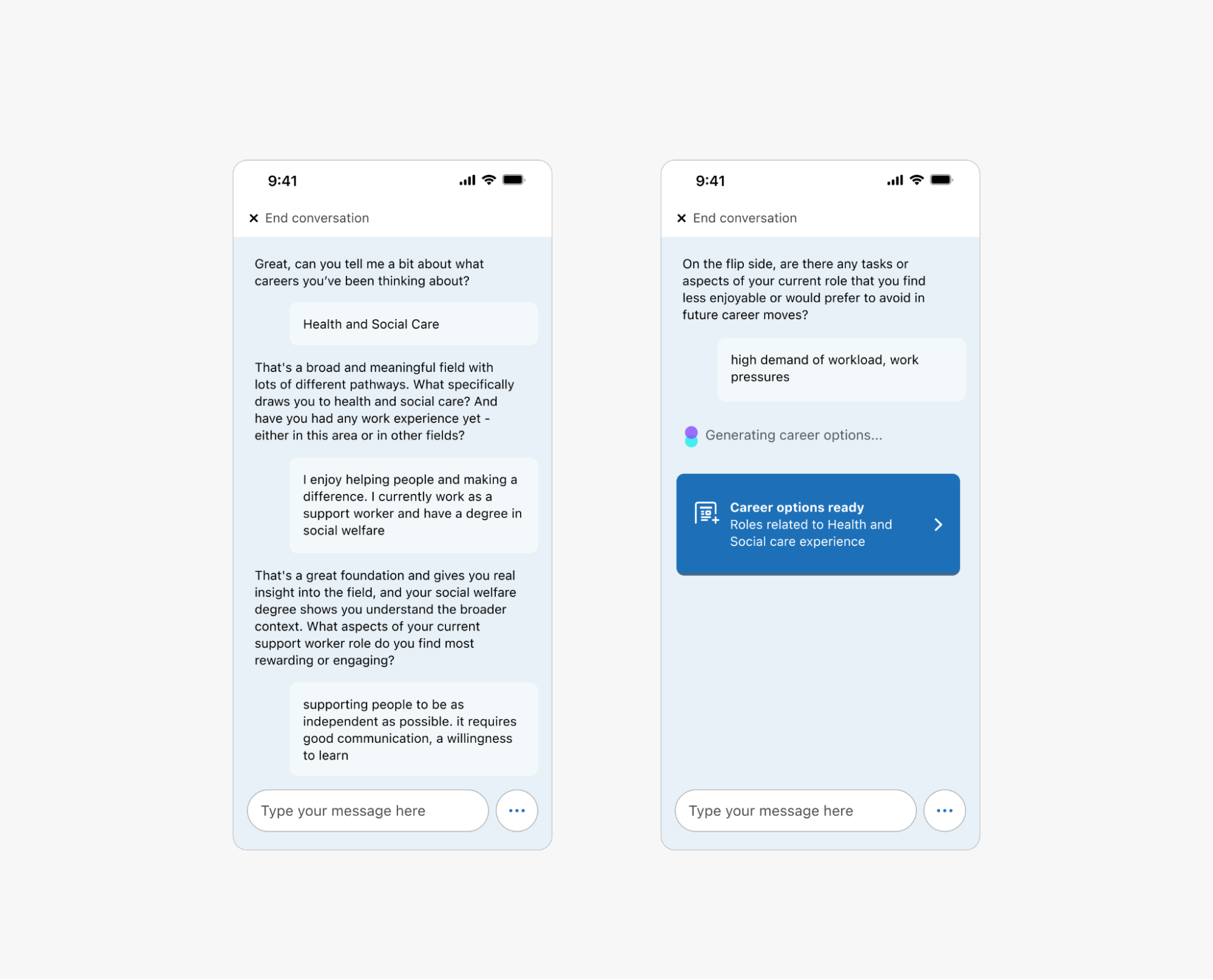
Another is about making generative recommendations, for example for personalised career options and bespoke next steps. To make useful recommendations, we are combining several data sources, including data from the National Career Service, Kings Trust and ONET, and storing them as a vector database. This, combined with the information we gather conversationally from the user, is used to generate relevant career descriptions and completely bespoke step-by-step plans.
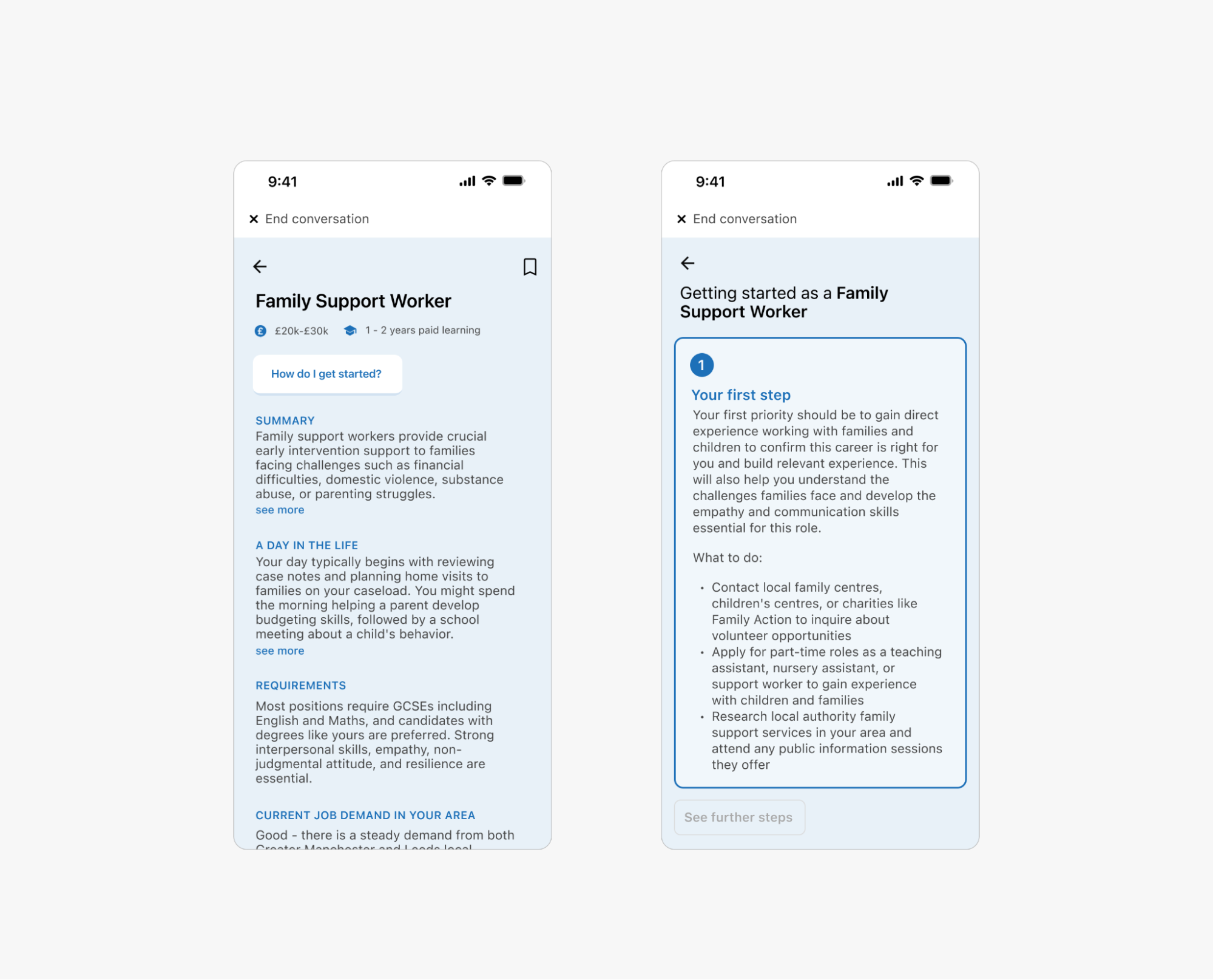
Building useful agentic AI services requires inventing a lot of new patterns. Prototyping is how we uncover them. To answer key questions such as ‘how chatty should the conversation be?’ or ‘how can we make the recommendations useful enough for people to want to use it?’, we have iterated different combinations of prompts, design components, and combinations of agents to get to outcomes that start to feel right. These prototypes use real code: using a tool like Figma is never sufficient when working with AI, because it doesn’t let you capture the nuance of generative output. We’ll continue to iterate our approach over the next few weeks.
We have just completed a round of research, putting our prototype in front of 16-24 year olds looking for help with their career - whether that’s finding a job, or deciding which kind of work is right for them, and the first signals are very positive. After trying the prototype to get career advice, one participant told us: “This feels completely personalised to me, my degree and the things I’m looking for…before, I felt like I needed advice but I didn’t know where to get actual practical next steps from, this gives me enough to go and try”
Expanding on our work
We’re excited to see such a positive reaction at this early stage of our work, but there’s still lots to do. Some of the more ambitious design challenges, such as truly dynamic and responsive journeys that cater for the variation of user’s challenges, are still to come as we continue developing the work over the next few months.
This first use case is our proof of concept for taking the potential of AI technology and applying it to a complex life moment. We are curious whether the capabilities, patterns and solutions we are developing could be applied to others, forming an approach to how we guide people through difficult tasks.
We would love to hear from anyone who is working on similar challenges, get in touch at govuk-ai@dsit.gov.uk.